
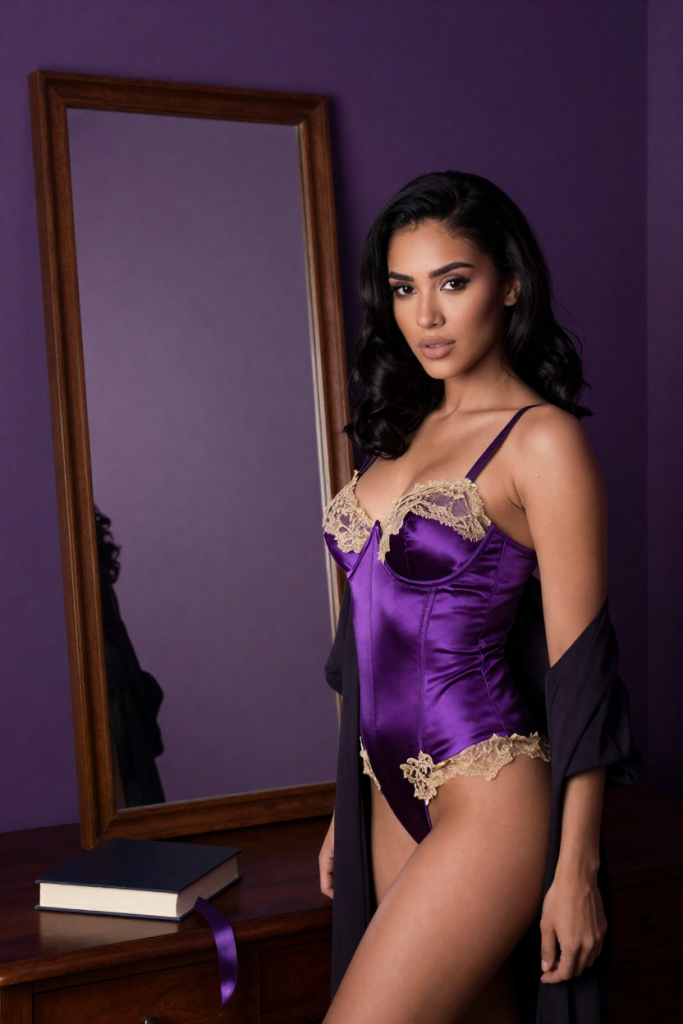
Visitors sometimes step around the desk to look into the mirror, and find a wall. The angle is deliberate. A mirror facing the room would put a second figure in every frame — doubled, reversed, and subtly wrong in the ways reflections are — and a series would spend its life arguing with its own glass. Worse, it would teach the wrong habit: checking her likeness in a flattering reflection instead of against the written record. So the mirror in this room reflects lamplight and plain plaster, and likeness is checked on paper.
A fixed point makes drift visible
Character drift is rarely dramatic. A jaw softens by a degree, a hairline migrates, the violet light deepens a shade. Against a changing background, none of that registers. Against the same tall plain frame in the same place, it registers at once. That is the mirror-stand’s whole job: to stand there, smooth and uncarved, identically, forever — a frame around nothing, marking the spot where checking happens.
The biography beside it
The mirror never appears without the closed biography beside it — cover plain, pages blank of any lettering, ribbon trailing from the spine. The pair is the room’s signature and its method in one image: the book is the life and the record of it; the glass is the vanity every studio owns and this one keeps turned to the wall. When you brief a frame here, you are setting the bench mark the next twenty frames will be judged against.
Questions
Do I have to include the mirror in my frames?
No — it is the house’s own habit, not a rule for members. But some fixed reference of your own, kept constant, will do the same work for your series.
Why is the book always closed?
Because nothing in it is meant to be read. A closed, letter-free cover keeps the frame about the woman and the sitting, never about text.
What should I check her likeness against?
The card, always — five written lines. A reflection flatters and forgets; a written line does neither.